
Photomedicine in Madrid · Photobiomodulation Therapy
Accelerate your body's cellular recovery and relieve pain through the science of photomedicine.
I am Dr Nicola Vilaplana, a dentist and orthodontist certified by SELO in the therapeutic use of laser and phototherapy in dentistry. My aim is twofold: to provide evidence-based information about photomedicine and how Photobiomodulation Therapy (PBMT or LLLT) can support the body’s natural repair and recovery processes, based on the available scientific evidence; and to offer advanced dental treatments at Clínica Dental del Rey in Madrid. We cut through false promises using scientific evidence, so you can make informed decisions about your oral and overall health.

What is Photobiomodulation Therapy?
A non-invasive treatment that uses light to help the body recover naturally — without cutting, burning or damaging tissue.
Photobiomodulation Therapy (PBMT) is part of photomedicine, the branch of medicine that uses light for therapeutic purposes. Unlike laser surgery or Photodynamic Therapy (PDT), photobiomodulation stimulates the body's natural biological processes rather than acting directly on the tissue.
The term Photobiomodulation Therapy was officially adopted in 2015 by the World Association for Photobiomodulation Therapy (WALT) to standardise the terminology used in research and clinical practice.

Benefits of PBMT

Pain relief
Significant reduction in acute and chronic pain. Helps interrupt pain signals in the nerves.

Reduces Inflammation
Reduces pro-inflammatory cytokines. Helps reduce oedema (swelling).

Promotes the Regeneration
Accelerates tissue repair and wound healing. Stimulates angiogenesis (the formation of new blood vessels).
Painless and non-invasive
No adverse side effects
Stimulates natural healing processes of the body
A brief history of light therapy
1903
Niels Ryberg Finsen is awarded the Nobel Prize for his research into the therapeutic effects of light.
1960s
Hungarian physician Endre Mester observes that low-intensity laser light promotes wound healing and tissue repair.
TWENTY-first century
2015
WALT officially adopts the term Photobiomodulation Therapy (PBMT) for use in research and clinical practice.
How does it work, cell-to-cell
The central idea is simple: to help cells function more efficiently,promoting tissue recovery and overall tissue health.
Mitochondrial Response
Light absorbed by the mitochondria (the cell’s energy centres) may temporarily increase ATP production (the cell’s energy currency), supporting tissue repair and recovery.
Modulation of Inflammation
Helps improve local circulation and regulate the body’s inflammatory response in the treated area.
Tissue repair
Helps reduce oxidative stress and cellular damage, accelerating the body’s natural tissue repair processes.
Visible Red Light (Superficial Penetration)
Commonly used for skin treatments, supporting wound
healing and improving hair health.
Near-Infrared Light (Deeper Penetration)
Reaches deeper tissues and is commonly used for
muscles and joints.
Wavelength
Determines how light interacts with tissue and how deeply it penetrates.
Power
The amount of energy emitted by the device during treatment.
Dose
The total amount of energy delivered during a treatment session.
Treatment Time
The duration of treatment for each area.
Treatment Frequency
The number and regularity of sessions throughout the treatment plan.
Applications of Photobiomodulation Therapy
Organised by body area.

Oral mucositis
One of the applications with the strongest scientific support. Clinical studies and international guidelines support its use to reduce oral pain, lessen the severity of mucositis caused by chemotherapy or radiotherapy, and improve tolerance to cancer treatment.
TMJ disorders
May help reduce joint and muscle pain associated with TMJ disorders and improve jaw function.
Oral surgery and dental extractions
May accelerate healing, reduce inflammation and help relieve pain after dental and surgical procedures.
Tooth sensitivity
Some studies suggest that it may help reduce sensitivity to cold or heat, although the evidence is still preliminary.
Dental implants
Early research is exploring whether it may support implant integration with the bone and help reduce post-surgical discomfort.
Orthodontics
Preliminary studies suggest that it may help reduce pain during tooth movement and accelerate orthodontic treatment.
Periodontitis and gingivitis
Some studies suggest that it may help reduce inflammation and complement conventional periodontal treatments.
Oral ulcers (mouth ulcers / canker sores)
Cold sores (herpes labialis)
Available research suggests that PBMT may be an effective tool for reducing pain, burning and inflammation associated with cold sore lesions and may support faster recovery.

Musculoskeletal pain
PBMT may help reduce pain, decrease local inflammation, improve mobility and support functional recovery in conditions such as neck pain, lower back pain, tendinopathies and sports injuries.
Muscle performance, strength & recovery
PBMT has shown consistent benefits in sports medicine, supporting post-exercise recovery, reducing muscle fatigue and delayed onset muscle soreness (DOMS), and enhancing physical performance.
Fibromyalgia
Some studies have shown favourable results in reducing pain and improving quality of life, although further research is needed.
Postoperative pain
Available research suggests that PBMT may help reduce pain and improve functional recovery following orthopaedic surgery.

Wound healing
PBMT has shown favourable results in supporting tissue repair, promoting wound healing and reducing local inflammation.
Dermatology & skin health
PBMT has been investigated for dermatological and aesthetic applications, including acne, facial rejuvenation, improving skin texture, scars and stretch marks, although much of the evidence is still evolving.
Hair health
Preliminary studies suggest that PBMT may help stimulate hair growth in people with androgenetic alopecia, although further research is needed.

Neuropathic pain
Some studies have reported improvements in pain perception, although results remain variable between treatment protocols.
Neurological disorders (stroke, Alzheimer's &
Parkinson's)
PBMT is being investigated for its potential in stroke recovery, traumatic brain injury, Alzheimer's disease, Parkinson's disease and mood disorders such as depression and post-traumatic stress disorder (PTSD).
Cognitive performance
Preliminary studies are investigating the potential effects of PBMT on attention, memory and executive function.

Age-related macular degeneration (Dry AMD)
Promising clinical trials have shown improvements in visual function and quality of life. It is one of the neurosensory applications with the strongest scientific support, although larger studies are needed to confirm these findings.
Lymphoedema
PBMT may help reduce the volume of lymphoedema and improve some symptoms, particularly when used alongside conventional treatment.
Sleep apnoea & other sleep disorders
Research is still preliminary. In obstructive sleep apnoea, the most promising results have been reported with photothermal laser treatments used to reshape the soft palate, a technique that differs from Photobiomodulation Therapy (PBMT). Other studies are investigating the potential of light to improve sleep quality by modulating circadian rhythms.
Tinnitus
Preliminary studies are investigating the potential of PBMT to reduce the symptoms of chronic tinnitus.
Cardiology
Ongoing research is investigating the potential use of PBMT as an adjunct to recovery following an acute myocardial infarction (heart attack).
Addiction treatment
Emerging research is investigating the potential role of PBMT in opioid use disorder and other addictions.
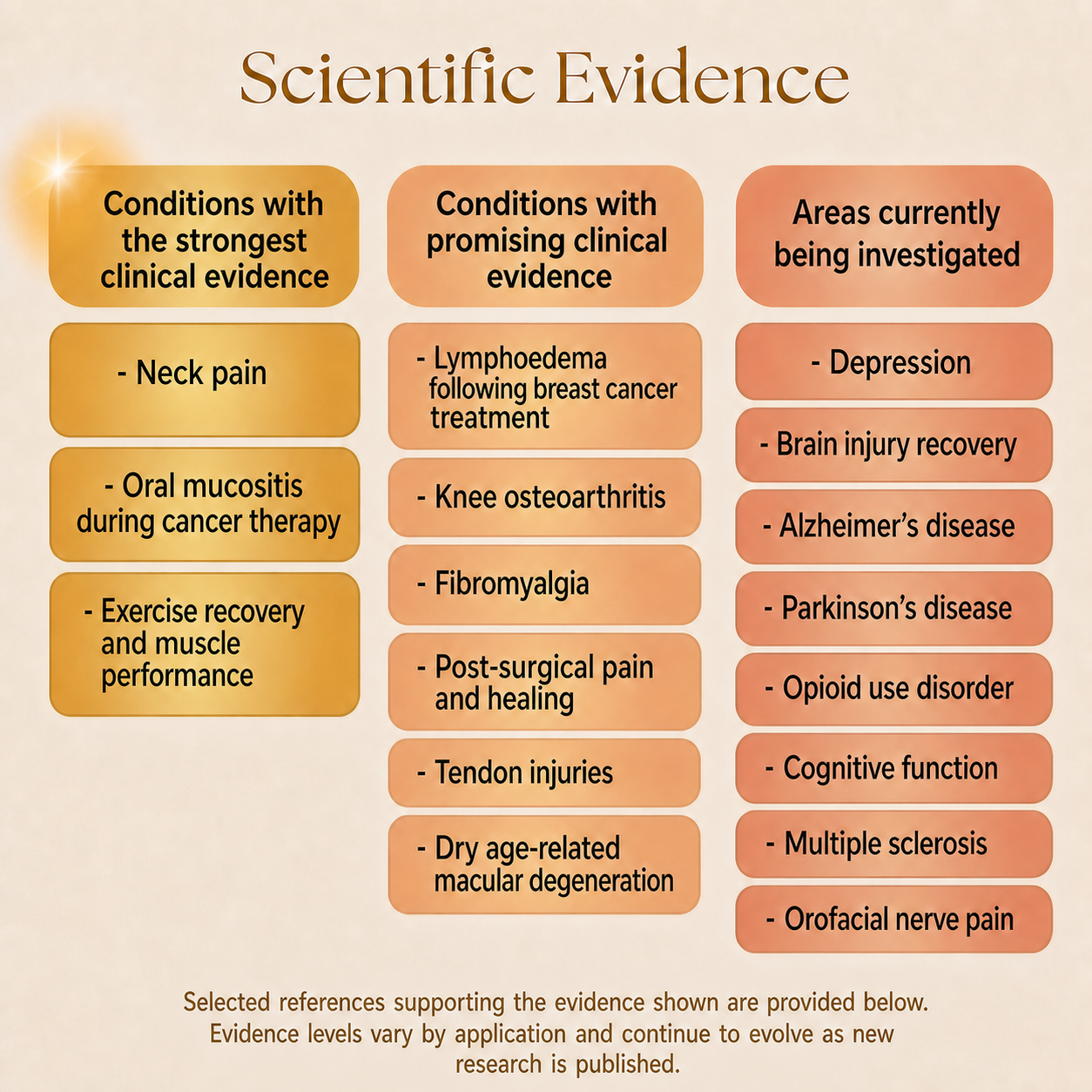
Selected references
The references presented here represent a selection of the scientific evidence—including clinical trials, systematic reviews, meta-analyses, consensus statements and clinical practice guidelines—supporting the applications shown.
Why can a single therapy help so many different health conditions?
It may seem surprising that the same therapy can be used for such different problems as back pain, a mouth ulcer or recovery following a stroke.
The reason is surprisingly simple: all of these conditions share a common underlying cellular problem. In most injuries and diseases, the affected cells are inflamed and produce less energy than they need to repair themselves.
Think of PBMT not as a medicine for a particular symptom, but as a "battery charger" for your cells. The therapeutic light is absorbed by the cells' powerhouses (the mitochondria), triggering a universal biological response:
- Reduces inflammation
- Increases cellular energy production
- Improves circulation
- Relieves pain

Rather than treating a specific disease, PBMT optimises your body's natural ability to heal. It gives your cells the tools they need to repair themselves, whether they are in a muscle, a nerve or the tissues of the mouth. This approach, which targets the underlying cellular problem, helps explain both its versatility and its growing scientific support.